

SEEING & PHOTOGRAPHING THE AURORA BOREALIS!
Witnessing the magical dance of the Northern Lights is an experience of a lifetime – the greatest fireworks display there is to see on Earth! Villa Aurorastone, Your exclusive luxury villa in Lapland, is ideally located, within the aurora oval, giving * You * the very best chances to see this incredible phenomenon.

While forecasting the Aurora is becoming increasingly reliable, You will also need darkness and a clear night to see it. Hence, autumn, winter and early spring combined with cloudless nights are the best opportunities to see the Aurora. In summer, the Aurora is not visible as white nights, when daylight lasts through the night, leave the stage to another beautiful show of nature: the midnight sun.
Short-term local aurora forecast data for Ivalo area can be had at the Finnish Meteorological Institute. We also recommend the use of applications like the Aurora Forecast, an invaluable tool in your pocket that can also send You notifications (1h ahead of an expected display).
The Aurora dances many nights a year above Villa Aurorastone – no word can describe the joy and awe seeing the Aurora Borealis dancing silently in the night sky. Imagine standing in winter on the frozen Lake Inari outside Villa Aurorastone and being surrounded by nature’s most incredible sky show, whilst stars glitter in the night sky! … Shall we add a glass of champagne with that?
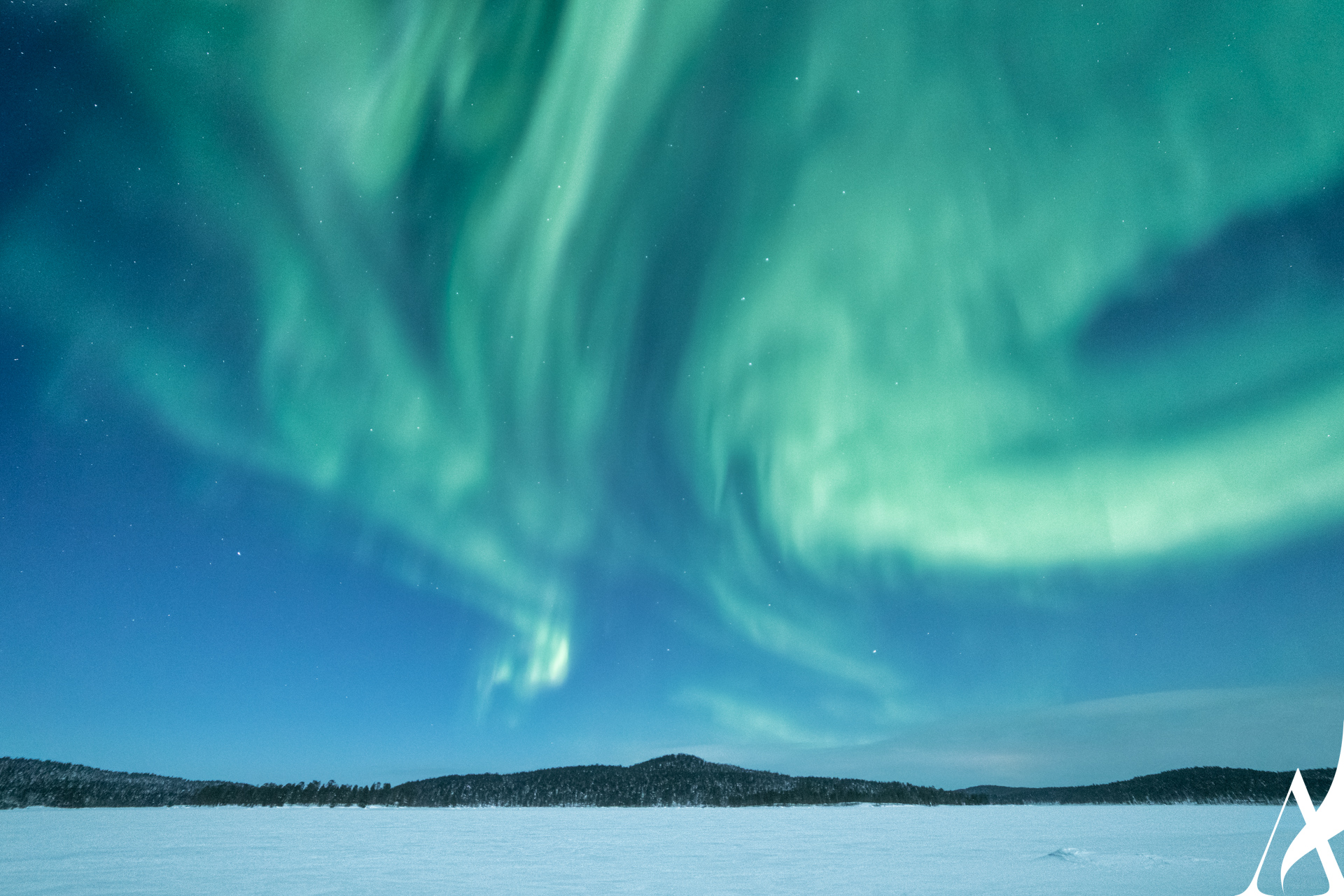
You most certainly will want to take “a piece” of the Aurora Borealis with You back home – and what other or better way than some beautiful photos? Should You be using a dedicated camera rather than Your phone, we collected a few tips below.
First things first: it is not difficult to take a picture of the Northern Lights, but it is easy to panic when the Green Lady dances above Your Head.
You will need the following:
- A wide angle lens (e.g. 16mm or lower) with a wide aperture (f/2.8 or lower)
- A (sturdy) tripod
- Manual focus, set at infinity – make sure you know how to do that in darkness; it helps focusing on bright stars/planets or the moon if it is visible.
- Manual exposure, with remote shutter release. Preferably use BULB mode as the aurora can change rapidly i.e. you can control the exposure time with the shutter release button rather than by adjusting the settings of Your camera.
- Set ISO depending on the intensity of the lights (trial and error): bright auroras can be shot as low as ISO400 while dimmer ones will require higher ISO e.g. ISO1600, ISO3200 for instance.
- De-activate in-camera noise reduction
- The exposure time is critical: it makes or breaks your photo. A good aurora shot is one where the structure of the aurora is visible. The aurora can be from very dynamic to very peaceful. The former requires shorter exposure, the latter tolerates longer exposure.
- A (very) dynamic aurora can be shot with 0.5s to 1s exposure time
- Slower auroras can be shot with 2~4s (sometimes a bit more) exposure time
- Do check the histogram of your photos – at night, underexposing your shot is very common. Avoid clipping of the highlights (1st) and shadows (2nd). Aim for a well spread histogram.
Photographing the Northern Lights in winter means it is likely going to be cold. In these conditions, remember to keep your spare batteries warm within the inner pocket of your jacket. Also, if snow is falling, remember to never blow directly on your lens as this will cause both fogging up of your lens, and melting of snowflakes; instead use a manual air blower.
That’s it – You are all set!
In wishing You a very warm welcome at Villa Aurorastone, we also wish You to witness the beautiful Northern Lights!

Villa Aurorastone, 68°N, Your Luxury Villa in Lapland, Finland